
FRANCISCO TOLEDO
Francisco Toledo developed one of the most distinctive visual languages in contemporary Latin American art. His imagery, populated by hybrid creatures, references to the natural world, and narratives rooted in Zapotec culture, forged a universal language that bridges tradition and experimentation. Through printmaking, painting, sculpture, and ceramics, Toledo explored the relationship between humanity, nature, and myth, establishing himself as an indispensable figure in the history of Mexican art.
ABOUT
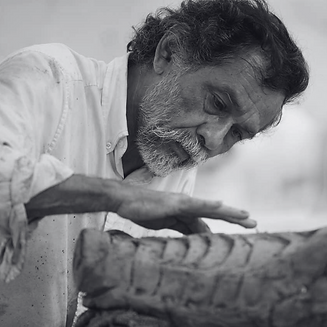
Francisco Toledo (Juchitán de Zaragoza, Oaxaca, 1940 – Oaxaca de Juárez, 2019) was one of the most influential and internationally acclaimed Mexican artists of his generation. A painter, printmaker, sculptor, ceramicist, draftsman, and cultural advocate, he developed a body of work deeply rooted in the traditions, worldview, and natural richness of Oaxaca, creating a unique visual language that transcended borders and generations.
From an early age, Toledo demonstrated a strong interest in drawing and the visual arts. He pursued his artistic education at the School of Design and Crafts of the National Institute of Fine Arts in Mexico City, where he began to shape the foundations of his creative practice. In the early 1960s, he moved to Paris, a pivotal period in his artistic development. There, he engaged with the international art scene and presented some of his first major exhibitions, launching a career that would soon gain worldwide recognition.
Over more than five decades of artistic production, Toledo explored a wide range of disciplines and techniques, particularly excelling in printmaking, painting, sculpture, and ceramics. His imagery drew inspiration from Zapotec culture, ancestral myths, and the natural world, giving rise to a universe inhabited by animals, hybrid creatures, and scenes rich in symbolism, sensuality, and humor. His work is distinguished by constant formal and material experimentation, as well as a profound reflection on the relationship between humanity and its environment.
Beyond his artistic achievements, Toledo played a vital role in the cultural life of Oaxaca. He promoted the creation of institutions dedicated to art, education, and cultural preservation, including the Oaxaca Institute of Graphic Arts (IAGO), the Manuel Álvarez Bravo Photographic Center, and the San Agustín Arts Center. His commitment extended beyond the arts, making him a passionate advocate for social and environmental causes, as well as for the rights of Indigenous communities.
His work was exhibited in major museums, galleries, and biennials throughout the Americas, Europe, and Asia, establishing him as one of the most significant figures in contemporary Latin American art. Throughout his career, he received numerous honors, including Mexico’s National Prize for Sciences and Arts and the Right Livelihood Award, often referred to as the “Alternative Nobel Prize.”
Francisco Toledo passed away on September 5, 2019, in the city of Oaxaca. His legacy endures not only through the vast body of work he created but also through the cultural institutions he helped establish. Widely regarded as an essential figure in contemporary Mexican art, his work continues to inspire new perspectives on identity, nature, and the cultural richness of Mexico.
ARTWORK
The papalotes are typical kites from Mexico made from various materials, such as dry branches or natural fabrics. Toledo was a great defender of Oaxaca's cultural legacy, were he is originally from. The kites decorated by himself reflect his interest in Mexican history and mythology, were numerous animals often play a key role. Toledo's creations brim with images from his childhood, all showcasing the Nahuatl belief that the destiny of every human being is closely linked to that of an Aztec spirit that has taken the form of an animal.


